"The Adventures of Langdon St. Ives" - читать интересную книгу автора (Blaylock James P.)
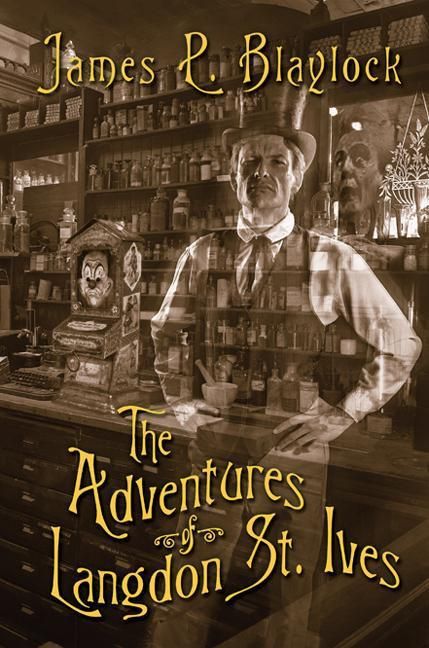 |
James P. Blaylock The Adventures of Langdon St. Ives
INTRODUCTION by Tim Powers
Nobody who knew him in 1972 would have guessed that James Blaylock would one day be the most original science fiction writer alive, which he now is, Cordwainer Smith and Philip K. Dick no longer being with us. Blaylock also writes fantasy, and some people would say that’s all he writes — but those people would be noting the consistent tone and assuming a consistent substance. Lovecraft’s several science fiction stories often get categorized as supernatural horror for the same reason.
In 1972, though, when he and I were in college, I don’t think many people would have guessed he’d be a writer at all. He was a dedicated surfer in his spare time, and his part-time job was doing construction clean-up — knocking down garages and sawing the roofs off of houses, sometimes at the wrong addresses by mistake. And for a while, before changing his major to English, he was a Psychology major. That didn’t work out, luckily — I can’t think of anybody less suited to that narrow discipline than Blaylock — though the world may have thereby lost a spectacular psychiatrist. I picture a sort of mix of Carl Jung and Federico Fellini.
He was already a writer, though. So was I. Neither of us had had anything published, but we were busily writing stories, and soon began long, never-to-be-finished novels. Of course we both read incessantly, the assigned books for our English literature classes blending in with the stuff we were reading on our own incentive, and it quickly became clear that, although in many ways we were writing the same sorts of adventure-and-grotesquerie stories, we were approaching them from very different points of the literary compass. I had grown up on writers like Fritz Leiber and Theodore Sturgeon, Henry Kuttner and Leigh Brackett, while Blaylock was operating from a foundation of Robert Louis Stevenson, Mark Twain, and P. G. Wodehouse.
And Lawrence Sterne. A lot of people love
Trim’s philosophy is echoed by many Blaylock characters, as when St. Ives says, in
And the business about radical heat and radical moisture particularly anticipates Blaylock, who likewise doesn’t hesitate to deal with principles of science in his fiction, especially in the St. Ives stories.
He is, as I said, a science fiction writer.
As in the Sterne passage, it’s generally antique science, to be sure. “It’s a little-known fact,” says Bill Kraken in
Maybe a better term would be crazy science. But it’s presented solemnly.
And it’s perfectly appropriate to the Victorian world Blaylock writes about — which isn’t precisely the Victorian world that actually existed. Fellow-writer K. W. Jeter got Blaylock and I interested in 19th century London with his 1979 novel
And while it might not be a perspective that exactly reflects the actual 19th century’s, neither does it reflect that of the 20th or 21st centuries. Blaylock isn’t really a citizen of those, literarily.
Raymond Chandler said once of his fictional private detective Philip Marlowe that he was a realistic character except in that such a person would never in real life become a private detective. The science fiction and fantasy fields have, more often than we could have hoped for, been the venue of writers who seem to have landed there by some mistake, who seem as if they should “in real life” have been writing a more obviously elevated sort of fiction. I think of Dick, and Ballard, and Tiptree, and Wolfe. And Blaylock, with his uniquely eccentric characters and locales and melodrama and humor, is certainly one of them too.
(support [a t] reallib.org)